
Energy security and sustainability through microgrids
In industries where power is essential, some form of backup power is likely already in place. But microgrids can offer security alongside, or even instead of, the grid. Graham Scandrett, Head of Electric Power Sales at Finning UK & Ireland, looks at how facilities managers can use microgrids to improve energy security while supporting sustainability.
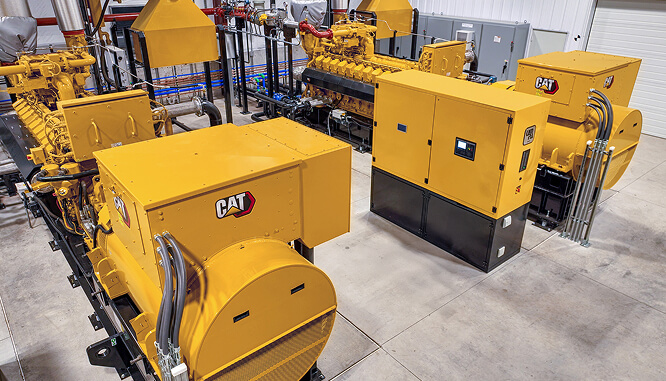
While the term ‘microgrid’ might conjure up images of complex infrastructure, this isn’t necessarily true. In general, to qualify as a microgrid, an energy system needs to meet two criteria:
1. It must be entirely self-sufficient and does not need to rely on any other source of power such as a national grid.
2. It must serve a specific geographic footprint. For example, a manufacturing facility, datacentre or hospital.
There are several important benefits from using an energy system of this type. Where high levels of resilience are needed to ensure consistent power, a self-contained microgrid can often be the most effective option given the control an organisation has over what energy is generated, when and how. As the transition to net zero encourages greater use of renewable, and therefore non-dispatchable, energy, this will become more important.
The precise mix of energy sources that feed a microgrid can be tailored for specific requirements, blending renewables with traditional sources where needed to reduce carbon emissions without compromising supply. Ultimately, these factors mean that it is possible for microgrids to provide a more sustainable and lower cost supply of energy than that which might be obtained through a national grid. Although of course energy from this source can still be used in parallel with a microgrid where required.
But as an evolving form of energy generation, there are challenges in how an organisation can ensure they are able to install and benefit from a microgrid design that properly meets their needs. The driver for many of these is the diversity of technology that can potentially be used.
The original microgrids were traditional generators powered by diesel but the concept has expanded to encompass the likes of wind, solar and combined heat and power (CHP) technology. These days, renewable sources may provide the bulk of the energy generation, but they are intermittent and require a consistent method to bridge any gaps in power. Traditional generators therefore remain the bedrock of many microgrids. This is due to the sheer reliability of this established technology, and changes in fuel sources mean sustainability improvements can be made. For example, Hydrotreated Vegetable Oil (HVO) offers up to 70% lower lifecycle carbon emissions compared to conventional diesel, and can be used in a generator with no modifications needed. And gas generators burn cleaner with lower NOx outputs, without the need for expensive after treatment equipment.
Those seeking to design a microgrid need to ensure that they have the correct control system format defined from the outset. Whilst centralised control systems mean that all components in the grid are consolidated into one interface, there are risks with this format in that one failure has the potential to disable the whole system. Therefore, in many cases a distributed control system is selected as despite the potentially higher costs resilience is increased.
There are not yet many industry standards in terms of microgrid design and in some countries navigating relevant regulations can also be a complex task. This makes it important to partner with an organisation that can bring experience in successful microgrid installations elsewhere. With the right partner in place, microgrids can offer a highly reliable, cost-effective and sustainable energy source.