
Historic totem pole raised on We Wai Kai Nation land in partnership with Finning
First totem pole erected on the Nation’s industrial development land at Quinsam Crossing marks cultural significance and economic reconciliation.
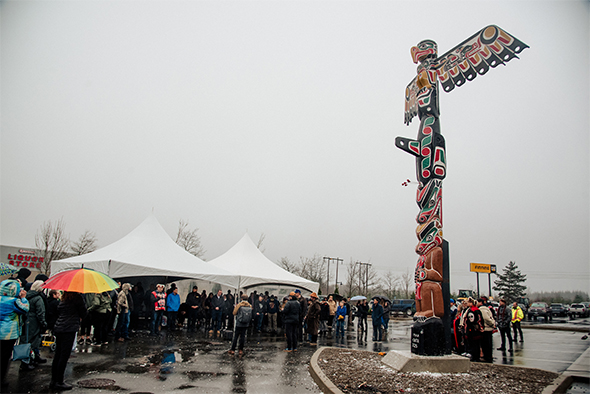
CAMPBELL RIVER, B.C. – In a ceremony celebrating cultural and economic reconciliation, the We Wai Kai Nation and Finning's Campbell River Branch raised the first totem pole on the Nation’s industrial land marking a significant milestone in their partnership.
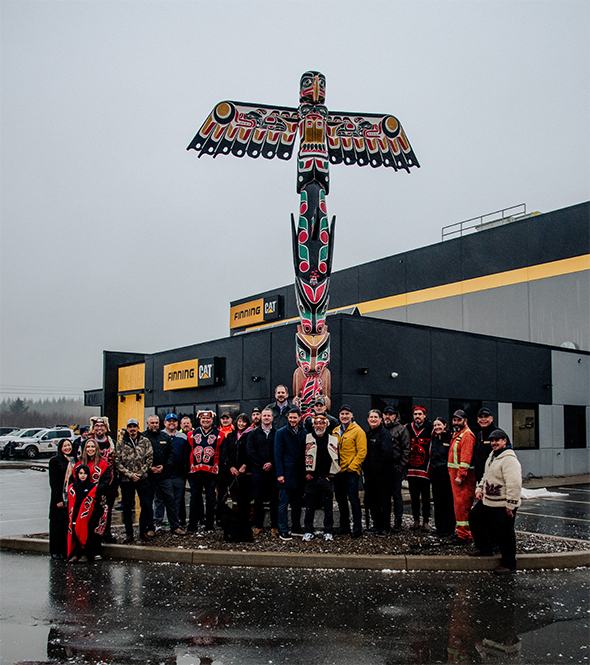
The 24-foot totem pole, carved from red cedar by renowned Lekwiltok artist and master carver Max Chickite, was unveiled in a ceremony attended by We Wai Kai Nation members and Finning employees. The installation represents both a cultural homecoming and a symbol of the growing collaboration between the Nation and Finning.
“The raising of this totem pole in partnership with Finning represents a meaningful collaboration rooted in respect, reconciliation, and shared purpose. As far as we know, this is the first totem pole ever raised in Quinsam—a proud expression of our cultural identity and enduring connection to these lands. It stands as a lasting symbol of the strength of our people and the importance of working together to honour the past while creating opportunities for the future.” Chief Ronnie Chickite, We Wai Kai Nation.
Cultural Significance
The totem pole features We Wai Kai Nations’s deep connection to their coastal territory in B.C. Chickite carved the totem pole using chainsaws, carving knives, and chisels, focusing on the wood’s grain and colouration to capture the animals’ life and movement. At the top, an eagle represents the sky’s power, while a whale symbolizes the ocean’s strength. A bear anchors the pole and draws power from the land.
"Totem poles tell a story of the people they represent. The bear represents the power of the land and I thought of the machines Finning sells that work so hard for so many different industries. The killer whale for the ocean’s strength and the Caterpillar engines that power our marine vessels. The eagle for the power of the sky, with faces on its wings symbolizing opposing forces — positive and negative, truth and falsehood—reflecting the choices we have as people,” shared master carver Max Chickite. “This pole will stand as a reminder that our culture is not something from the past. It's alive, it's powerful, and it belongs here on our land."
“Our partnership with Finning exemplifies the kind of meaningful collaboration we strive to build—one that honours We Wai Kai culture while advancing shared economic opportunities,” said Jason Wilson, Director of Economic Development, We Wai Kai Nation. “By providing space for our artists to continue their traditions, Finning is demonstrating leadership in supporting Indigenous cultural expression and economic reconciliation. Together, we are creating a model where cultural strength and sustainable development move forward hand in hand.”
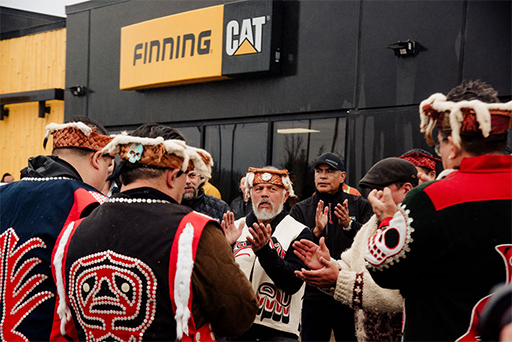
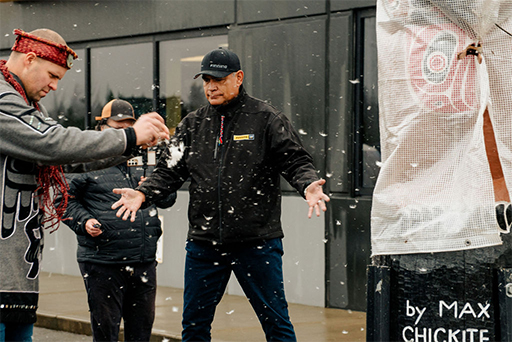
Chickite began carving the totem pole in May 2025 in Finning's Campbell River facility yard before completing the detailed work at his studio and painted alongside his daughter, Jessica Chickite and his apprentice Brent Smith. Chickite extended the invitation to Finning employees to take part in painting as well.
"When we talk about reconciliation, we hear a lot about it—now we have an actual piece of what reconciliation is," said Neil Lehane, Response Supervisor, Finning Campbell River. "Watching Max work changed how we think about craftsmanship. With laser-sharp cuts from a freehand chainsaw, we watched the log come to life. Max once told us the animals are already in the wood, and his job is just to uncover them. This totem pole represents our shared values of respect, reconciliation, and community. It's an honour to be part of something so meaningful with the We Wai Kai Nation.
Economic Partnership
In 2022, Finning became the first business tenant in a number of years in the We Wai Kai Nation's industrial development area at Quinsam Crossing.
The partnership reflects the Nation's broader economic development strategy, which includes acquiring interests in forestry operations and developing new commercial and residential properties. Chief Ronnie Chickite, re-elected for a second term earlier this year, has emphasized the Nation's goal of achieving greater self-sufficiency through strategic partnerships and focusing on language and culture revitalization. Campbell River is Finning’s third facility on Nation-owned land in Western Canada. The company has worked with other First Nations to form long-term partnerships through lease agreements for their Kamloops facility on Tkemlúps te Secwépemc territory and Fort McKay facility in Alex & Alice Bouchier Industrial Park on Fort McKay First Nation.
This installation marks the first totem pole erected in the Nation’s newly established industrial area and first ever at any Finning facility.
About We Wai Kai Nation
The We Wai Kai Nation is a progressive Indigenous government based on the traditional territory of the Ligwiłdaxw people, with communities located on Quadra Island and in Campbell River, British Columbia. Guided by a vision of self-determination and cultural resurgence, the Nation is committed to building a sustainable future through economic development, environmental stewardship, and community well-being. We Wai Kai actively pursues partnerships and projects that create opportunity, honour its culture, and strengthen its role as a leader in Indigenous governance and business development on Vancouver Island.
About the Artist
Max Chickite is a Lekwiltok artist, born in 1958, and member of the Ligwiłdaxw Nation from Cape Mudge on Quadra Island, BC. He is the great-grandson of former Chief Johnny Chickite. At the age of eleven, Max began drawing, painting, and carving.
In 1994 Max created a Bukwas carving, which won an Award of Excellence in Campbell River, BC and Cumberland, BC. It was then chosen for the poster of the “Images & Objects” Exhibition for the Provincial Exhibition which was held in Campbell River for the BC Festival of the Arts.
In 1997, due to his carving skills, Max was hired by Walt Disney to be a sculptor for the movie “Eaters of the Dead”. That same year, Max was nominated at “Citizen of the Year” in Campbell River. His work is featured in Vancouver's Stanley Park, Scottsdale, Arizona, and Switzerland. Max enjoys sharing his knowledge of First Nations art by volunteering his time in many of the schools within his community.
Finning is the world's largest Caterpillar dealer, selling, renting and providing parts and service for equipment and engines to customers across diverse industries, including mining, construction, petroleum, forestry and a wide range of power systems applications. We operate in Western Canada, South America, and UK and Ireland.